
Lead-Free Tin Plating and Tin Whiskers in Electronics Manufacturing
At the Sur/Fin 2000 Conference, the annual technical conference and exhibition of the American Electroplaters and Surface Finishers Society (AESF), an entire technical session was dedicated to addressing a growing concern in the electronics industry: the removal of lead from tin deposits and soldered joints.
Driven by environmental regulations and global compliance standards, electronics manufacturers are actively transitioning away from lead-containing materials. Traditionally, solder alloys consisted of approximately 60% tin and 40% lead, offering excellent performance and long-term reliability. However, eliminating lead has introduced new technical challenges—most notably, the emergence of tin whiskers.
Lead removal initiatives are not new. Industries such as plumbing, coatings, and fuel production eliminated lead decades ago due to public health risks. However, unlike paints or gasoline additives, lead-free solder and tin plating alternatives have proven far more complex, particularly for high-reliability electronic applications.
What Are Tin Whiskers?
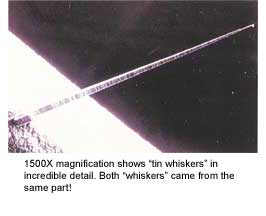
Tin whiskers are microscopic, needle-like metallic filaments that spontaneously grow from tin-plated surfaces. This phenomenon has been observed in pure tin, cadmium, and zinc deposits, but it poses the greatest risk in modern electronics.
A well-known example involved Raytheon, where intermittent missile misfires were ultimately traced to tin whisker-induced electrical shorting using high-resolution electron microscopy. These findings elevated tin whiskers from a theoretical concern to a critical reliability issue.
Why Tin Whiskers Are a Serious Reliability Risk
- Miniaturization of electronics: As electronic components shrink, even microscopic whiskers can cause catastrophic short circuits.
- Spontaneous growth: Tin whiskers can form without warning under a wide range of environmental conditions, including thermal cycling and vacuum.
- Unpredictable incubation periods: Whiskers may appear within days—or take up to 10 years to develop—making them extremely difficult to mitigate through testing alone.
Controlling Tin Whiskers with Alloyed Tin Coatings
Tin whiskers were first formally documented in 1956 at the Platers’ Technical Conference. Despite decades of research, the exact cause remains debated. The prevailing theory links whisker formation to a material’s need to relieve compressive stress within the plated deposit or base metal.
One of the most effective mitigation strategies is alloying tin with lead or bismuth. While traditional 60/40 tin-lead plating significantly reduces whisker growth, some military and aerospace specifications require as little as 3% lead by weight to achieve control.
Bismuth-doped tin coatings require even lower concentrations. Specifications from IBM and Rockwell mandate a minimum of 0.3% bismuth by weight to suppress whisker formation.
Anoplate’s AnoTin Bi is a bismuth-alloyed tin deposit engineered to meet both IBM and Rockwell specifications. Anoplate is an approved supplier for both organizations, delivering reliable lead-free solutions for high-reliability electronics.
Lead-Free Solder Alternatives and Reflow Processing
Reflow processing is widely recognized as a secondary method for reducing tin whisker risk. This process involves immersing freshly plated components in a 460°F oil bath for 10–15 seconds, allowing the tin to melt, smooth grain boundaries, and reduce internal stress.
The result is a brighter, more uniform, and nearly stress-free tin surface. However, it is important to note that no pure tin deposit is completely immune to whisker formation.
Environmental regulations—particularly in Europe—continue to drive demand for lead-free solder alternatives. Research published in the Transactions of the Institute of Metal Finishing evaluated eight lead-free solder formulations containing silver, copper, antimony, indium, and bismuth.
Using EPA TCLP leaching protocols and international regulatory standards, researchers concluded that all alternatives except tin-bismuth exceeded acceptable toxicity thresholds. Their conclusion emphasized that lead-free solders are not a universal solution to environmental or reliability concerns.
Anoplate continues to offer a full range of tin and alloyed tin finishes, including 60/40 and 90/10 tin-lead alloys, tin-bismuth, matte tin, and bright tin to support diverse electronic finishing requirements.
Learn more about our tin alloy solutions on the AnoTin page.
For expert guidance on your electronic finishing application, contact Anoplate today.