Electroless Nickel Plating Flaking on ID | Burnt-On Nylon Masking Explained
Quick Answer: Missing or flaking electroless nickel plating on an inside diameter (ID) is often caused by surface contamination. In this case, overheated nylon from an abrasive deburring brush acted as a maskant and prevented plating adhesion.
Customer Question
Q: We recently sent you a group of parts to be electroless nickel plated and upon return noted that they exhibited missing or flaking plating on the ID. What happened?
Location: Machine Shop Customer – Moonachie, New Jersey (NJ)
Technical Analysis
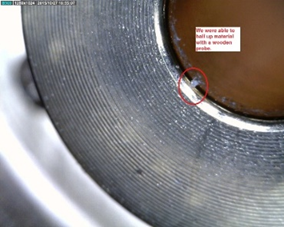 A: Upon microscopic examination of the returned parts, there was noted a white “glob” at the top edge of each of the parts. Using a wooden stick the material could be mechanically separated from the part exposing raw, untreated substrate material beneath. We chemically removed the plating from a couple of parts and the “glob” was untouched indicating that the white material was not typical plating salts or residual alkaline cleaning salts.
Upon further discussion with the customer, they indicated the parts had undergone a final deburring using an abrasive nylon brush. Such brushes are becoming popular over wire filament brushes due to their ability to encapsulate more abrasive particulates including aluminum oxide, silicon carbide or even diamond. They are composed of heat stabilized nylon and abrasive grains that are then coextruded into monofilament brushes containing about 30% by weight of the abrasive.
Used at the proper speed and ensuring that there is sufficient abrasive remaining, they function well. However, as the abrasive content is depleted and the machinist extends the deburring time to compensate, there can be a tendency for the nylon to overheat and leave melted nylon residue on the otherwise deburred part.
As the old chemist adage goes, “like dissolves like.” Because plating houses only use inorganic chemicals in cleaning and activating parts for subsequent electroless nickel plating, the nylon remains intact and acts as a maskant, preventing the area beneath from being plated.
Even using an organic solvent such as alcohol, MEK, or trichloroethylene, burnt-on nylon is relatively inert and often unaffected by simple chemical cleaning.
In the end, we stripped the parts, returned them to the customer to be deburred using new abrasive brushes, and the parts were successfully returned to Anoplate for re-plating without issue.
Root Cause Summary (For Quick Diagnosis)
- Symptom: Missing or flaking electroless nickel plating on ID surfaces
- Root Cause: Burnt-on nylon residue from abrasive deburring brush acting as a maskant
- Why It Failed: Nylon contamination is not removed by standard inorganic pre-plate cleaning processes
- Corrective Action: Strip plating, re-deburr with fresh abrasive nylon brushes, then re-plate
Related Topics: electroless nickel plating adhesion failure, plating flaking on inside diameter, burnt nylon contamination, EN plating troubleshooting, Nadcap plating processes, plating surface preparation, masking contamination before plating.
Legacy Keywords: electroless Nickel Plating, Burnt on Nylon, chromic acid, passivate, passivated, mil-spec, black anodized aluminum, silver plating, mil std, electroplating near me, mil std 202, nickel thickness